
I have argued, for almost four years now, that inflation was going to make a comeback. Obviously, my reasoning had nothing to do with the pandemic or even a new cold war. No, my reasoning was largely based on the fact that people had written inflation off entirely and, as a result, they had been acting in ways that ensured it would return and in a big way. In fact, what we have seen materialize over the past few years is not only a return of cyclical inflation but the rise of a perfect storm of structural inflationary forces in the economy.
Perhaps the most obvious example of this is the shift in monetary policy at the Federal Reserve. Believing that too-low inflation was, “one of the major challenges of our time,” Jay Powell saw fit to print over $5 trillion of new money, nearly 25% of GDP, in less than two years’ time only after implementing policy that mandated it would fall way behind the curve. And still people were surprised by the rise in inflation last year! As Ray Dalio said, “Where is the understanding of history and the common sense about the quantity of money and credit and the amount of inflation?” M2 is still growing at the fastest rate since 1983 and the Fed Funds rate is still pinned at zero percent. So much for too-low inflation.
Even less appreciated are the demographic forces of inflation. Having had a surplus of labor for decades employers got very comfortable implementing more and more policies that benefit the corporation at the expense of the worker. These include non-compete agreements (even in the fast food industry), anti-union policies, the end of the pension, and hourly pay rates well below the poverty level, etc. Now that the supply of labor is constrained (due to retiring baby boomers and a shift in the trend towards offshoring) employers are now forced to dramatically raise wages and benefits, potentially creating a wage-price spiral.
Add to this trend the regulatory shift in antitrust policy that allowed for a dramatic increase in corporate concentration. Certainly, the broad decline in inflation since the early-1980’s and the rise of the internet as a disinflationary force had a great deal of influence on regulators’ decision to allow for a massive boom in mergers and acquisitions in recent years. Even if the individual transactions were not obviously inflationary, the end result of the mass of them is, indeed. Even in the world of tech, known for coining the phrase “creative destruction,” there has been a dramatic drop-off in competition and a huge rise in profits.
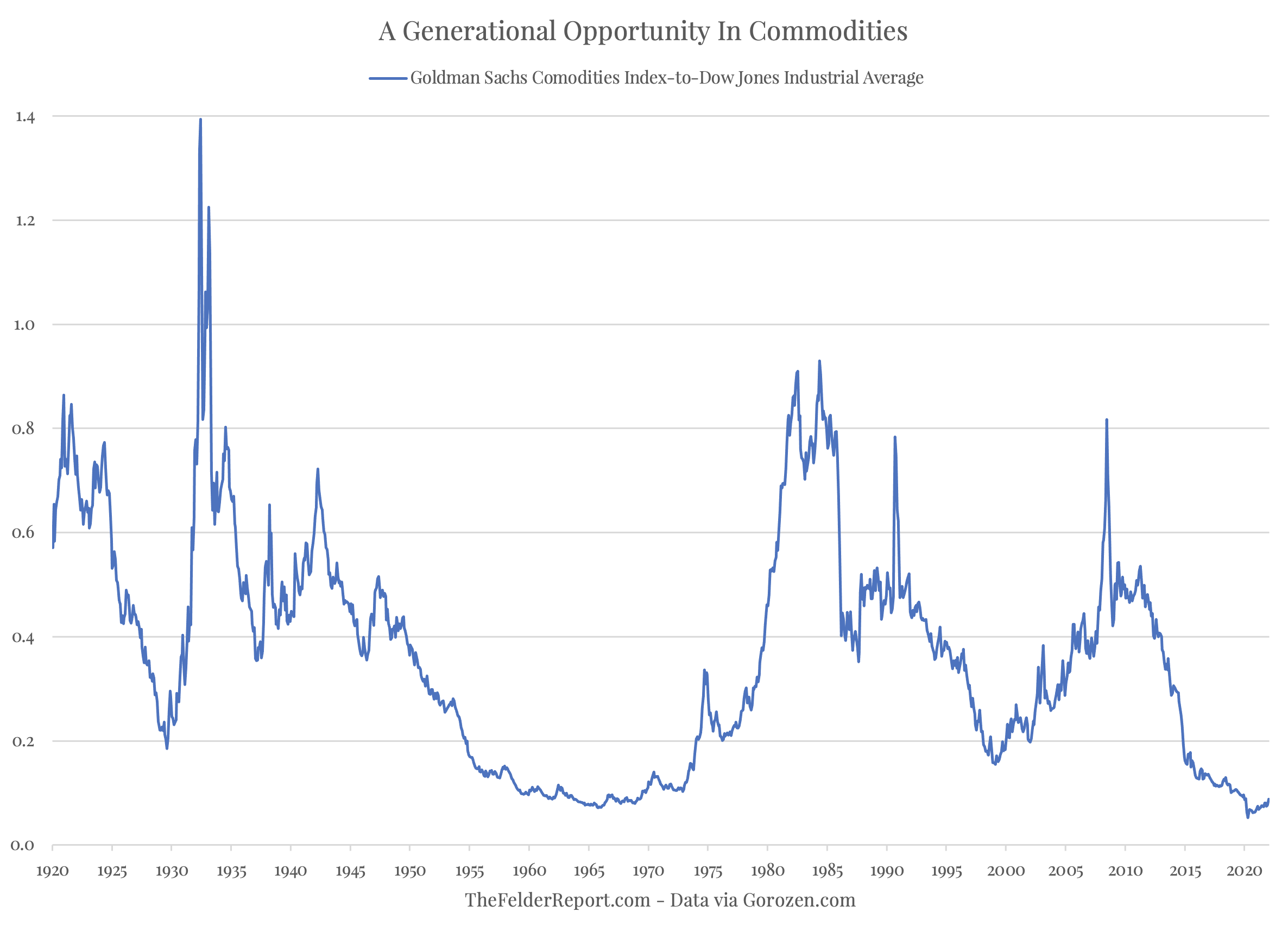 At the same time, there has been a massive underinvestment in the commodities sector. It is true that much of this is simply the natural cycle of the industry: a boom in prices attracts capital that results in a bust and vice versa. But, as my friends at Goehring & Rozencwajg note, the recent bust in commodities has been exacerbated by the trend, in both markets and politics, towards ESG. So, as prices are now rebounding, production is not following suit due to the strong disincentives provided by both investors and governments. For this reason, the old saying, “the cure for high prices is high prices,” may prove relative during the current cycle.
Finally, it’s astounding to think now, in light of how relations with Russia and China have deteriorated, about how reliant western economies have become on these two countries to meet their basic needs. Europe has decimated its own energy industry and is now almost wholly reliant on Russia for its supplies. And America has decimated its manufacturing industry and is now almost wholly reliant on China for production of goods. A new cold war between these two and the west, almost regardless of how it plays out, represents yet another inflationary impulse. Renewing energy infrastructure and reshoring of production is a costly business, much costlier than outsourcing these things.
In each case, investors, central bankers and policy makers took for granted that inflation would remain low no matter what decisions they made or how they acted. How else can you explain the decision to print $5 trillion in a years’ time or to disenfranchise labor or to encourage monopolies and duopolies through lax regulatory policy or to structurally hamper the production of necessary raw materials, or to outsource production of energy and goods (even those crucial to national security) to potential rivals with an interest in reshaping the world order in their favor?
You may now see the point that I’m getting at. Rectifying these issues is not as simple as raising interest rates or reducing the Fed’s balance sheet. They are much larger than your typical cyclical inflation problem. They are structural in nature and thus require structural remedies. Those don’t come overnight. A true normalization of monetary policy could take many years if not a decade or more. Demographic trends take even longer to play out. Regulators have only begun to address antitrust policy and it may require much higher prices this time for people to see the need for investing in raw materials, notably energy. Finally, a new cold war is not something that will just go away overnight, either.
The trouble for the Fed is that it is now tasked with “fixing” the inflation problem but its tools are only very good at reducing inflation by reducing demand. So it would appear that the Fed now finds itself in exactly the opposite situation of the past decade. Decades of disinflation and, since 2009, persistently low inflation have allowed the central bank to consistently attempt to stimulate the economy by way of goosing the asset markets like never before. Now, however, persistently high inflation may mean they have to consistently apply the brakes to the economy by way of the asset markets.
More importantly, however, is the fact that, perhaps no matter what the Fed does or doesn’t do, inflation will remain a challenge until these structural issues are either adequately addressed or simply play themselves out over time. Either way, it seems crucial to understand that they represent far more than a mere cyclical rise in inflation exacerbated by supply chain issues created by the pandemic. If that were the case, investors could continue to utilize the playbook that has worked so well in recent years, namely the overweighting of financial assets. The reality of the current situation seems to call for an entirely new playbook, heavily skewed toward real ones.
If so, markets have only begun to adjust to this new reality. Risk assets that can no longer depend upon a central bank willing to do “whatever it takes” to support prices may deserve much lower valuations (and higher risk premiums). And real assets, like commodities and precious metals, may prove far more valuable to investors looking to preserve purchasing power than markets currently seem to appreciate. In other words, this year’s market trends, of falling stock and bond prices and rising commodities prices, may be only in the very early innings.