

Below are some of the most interesting things I came across this week. Click here to subscribe to our free weekly newsletter and get this post delivered to your inbox each Saturday morning.
LINK
“A kind of gambling fever seems to be setting in. In February and March, asset managers filed to launch dozens of exchange-traded funds that would seek to quadruple or even quintuple the daily returns on stocks and other assets, even though regulators have reportedly indicated they might not be approved. On prediction markets, you can bet whether the price of bitcoin will go up or down in the next five to 15 minutes—24 hours a day,” writes Jason Zweig.

LINK
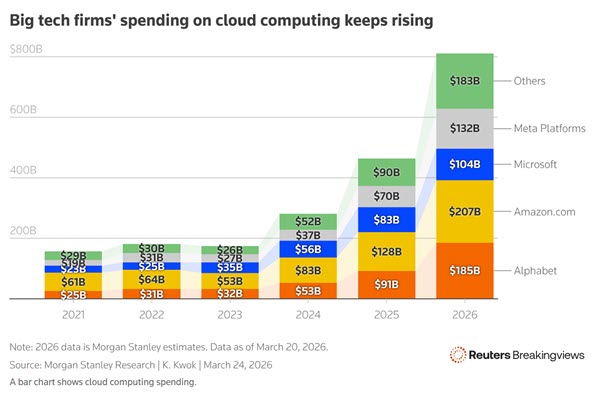
Much of the speculation is centered on companies that are the greatest beneficiaries of the AI Boom. As Jamie McGeever writes, “The all-powerful sector’s earnings are expected to rise 46% in the first quarter, meaning tech would account for nearly 80% of the expected $74 billion total profit growth. But ‘Big Tech’, with its $800 billion capital expenditure plans on energy-intensive data centers and other artificial intelligence infrastructure this year – much of it debt-financed – is now particularly sensitive to both soaring energy prices and the cost of money.”
LINK
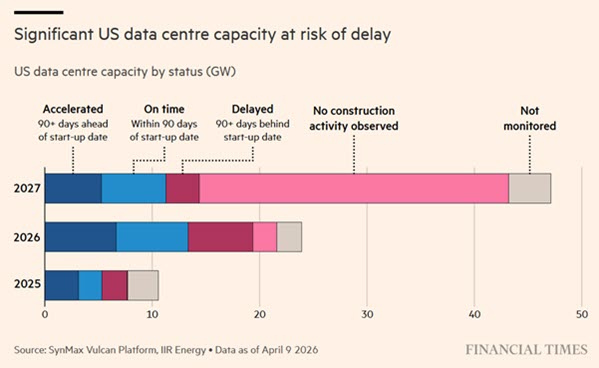
At the same time, “bottlenecks are emerging as a key constraint on how quickly companies can turn vast spending on AI into revenue, raising concerns that billions in planned investment will take longer than expected to generate returns,” reports The Financial Times.
LINK
Meanwhile, the problem of hallucinations has not been solved: “What appeared to Olson to be a data breach was actually a fabrication by the chatbot, Google told The Wall Street Journal. The account it referenced wasn’t active, and the senders wanting liquor and ice cream didn’t exist, the company determined in an internal probe.”

PODCAST
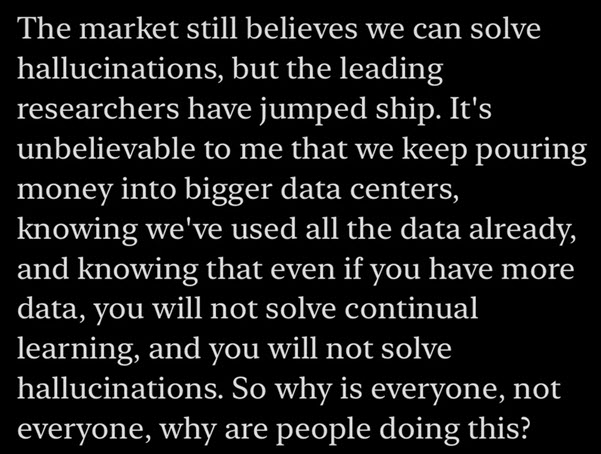
More researchers are apparently coming to the conclusion that, in its current form, no amount of scaling Generative AI will ever solve the problem. So, as AI expert Janusz Marecki argues, why not just focus on employing smaller, more efficient models that can run locally, without the need for a data center at all?
For a deeper analysis of these themes and what they mean for your investments subscribe to The Felder Report PREMIUM and get instant access to our Market Comments, Monthly Chartbooks, Tactical ETF Portfolio and more.