

Eli Lilly (LLY) saw its stock price crater earlier this month after the company announced that its recent clinical trial for its new weight-loss pill showed disappointing efficacy: patients lost 12% of their body weight over 72 weeks rather than the 15% expected by analysts.
In reaction to the stock price decline, however, insiders stepped in to buy shares and in a big way. Eight different directors and executives all made purchases in the open market recently at prices ranging from about $640 to $690 per share (data via InsideArbitrage.com):
| Owner | Relationship | Date | Cost | Shares | Value |
| Lucas Montarce | EVP & CFO | 15-Aug-25 | $691.79 | 715 | $494,627.00 |
| Ralph Alvarez | Director | 13-Aug-25 | $660.25 | 758 | $500,473.00 |
| Naarden Jacob Van | EVP & Pres., Lilly Oncology | 13-Aug-25 | $647.36 | 1,000 | $647,360.00 |
| David A. Ricks | President, Chair, and CEO | 12-Aug-25 | $644.77 | 1,632 | $1,052,263.00 |
| Daniel Skovronsky | EVP, CSO & Pres. LRL & LLY Imm | 12-Aug-25 | $634.41 | 1,000 | $634,405.00 |
| Gabrielle Sulzberger | Director | 12-Aug-25 | $641.18 | 117 | $75,018.00 |
| J Erik Fyrwald | Director | 12-Aug-25 | $642.33 | 1,565 | $1,005,242.00 |
| Jamere Jackson | Director | 8-Aug-25 | $639.56 | 200 | $127,913.00 |
Clearly, these folks are not nearly as concerned as analysts over the “miss” in terms of efficacy and see the shares as a bargain. It may be that they know that most patients will still opt for a pill versus and injection or simply that after a period of injections patients may choose to switch to a pill to prevent regaining the lost pounds.
Either way, it’s difficult to see this sort of buying as anything other than a vote of confidence in the value the shares represent in the mid-$600 range. Considering the fact that the PE Ratio has roughly been halved over the past year, there’s a case to be made that the shares offer much better value than they did at the end of 2023, the year Zepbound (the company’s injectable GLP-1) came out.
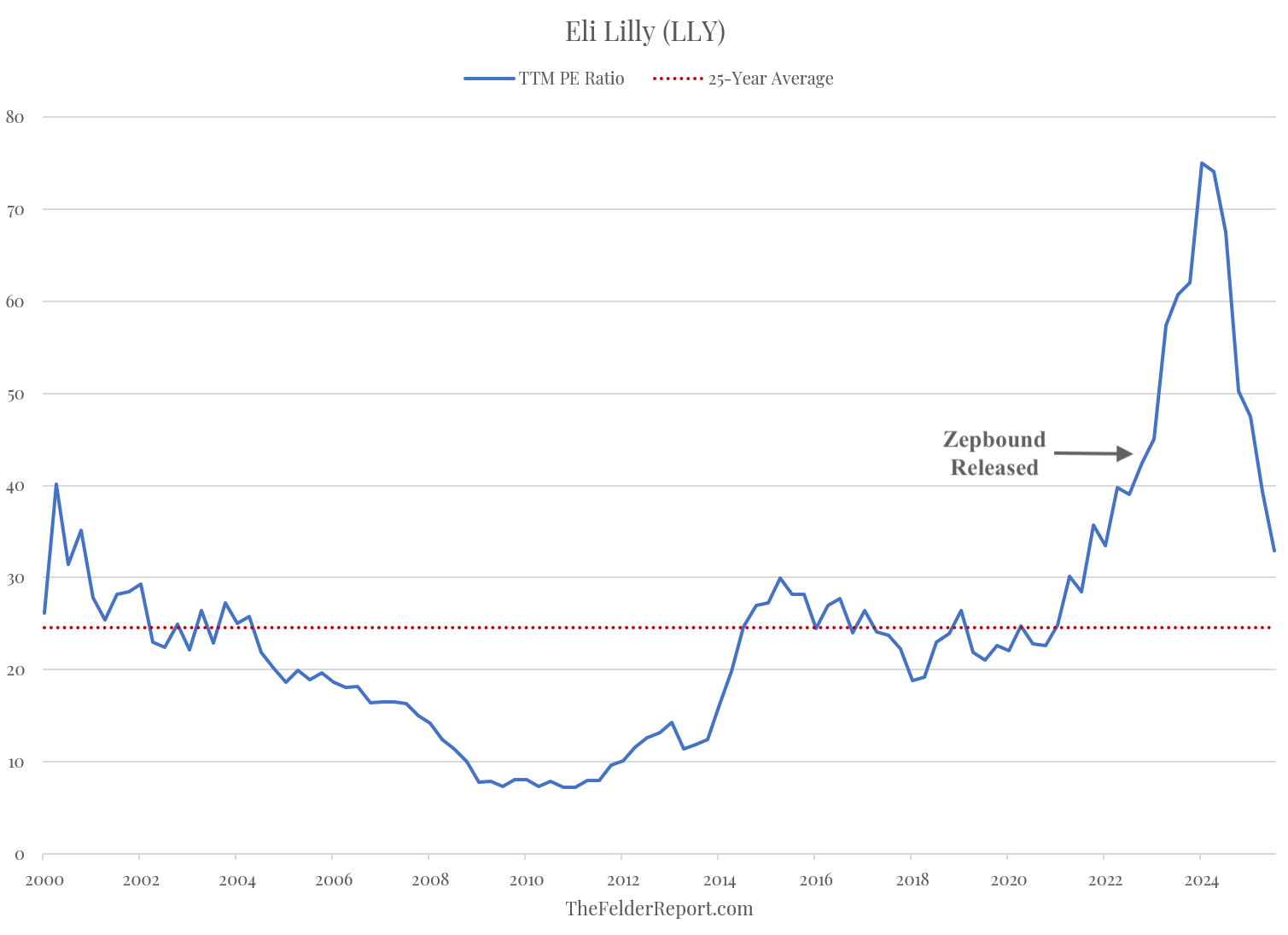
Still, it’s hard to argue the shares are significantly undervalued unless you believe the quadrupling of earnings per share over the past few years is going to be repeated over the next few. With increasing competition in the space, the market rapidly becoming saturated, and more news about side effects coming out, that may be a stretch.
From a technical standpoint, the stock looks to be finding support at its long-term 3-year moving average. However, momentum has broken down below two key structures that suggest it may take a good deal of time (months) to repair the damage.
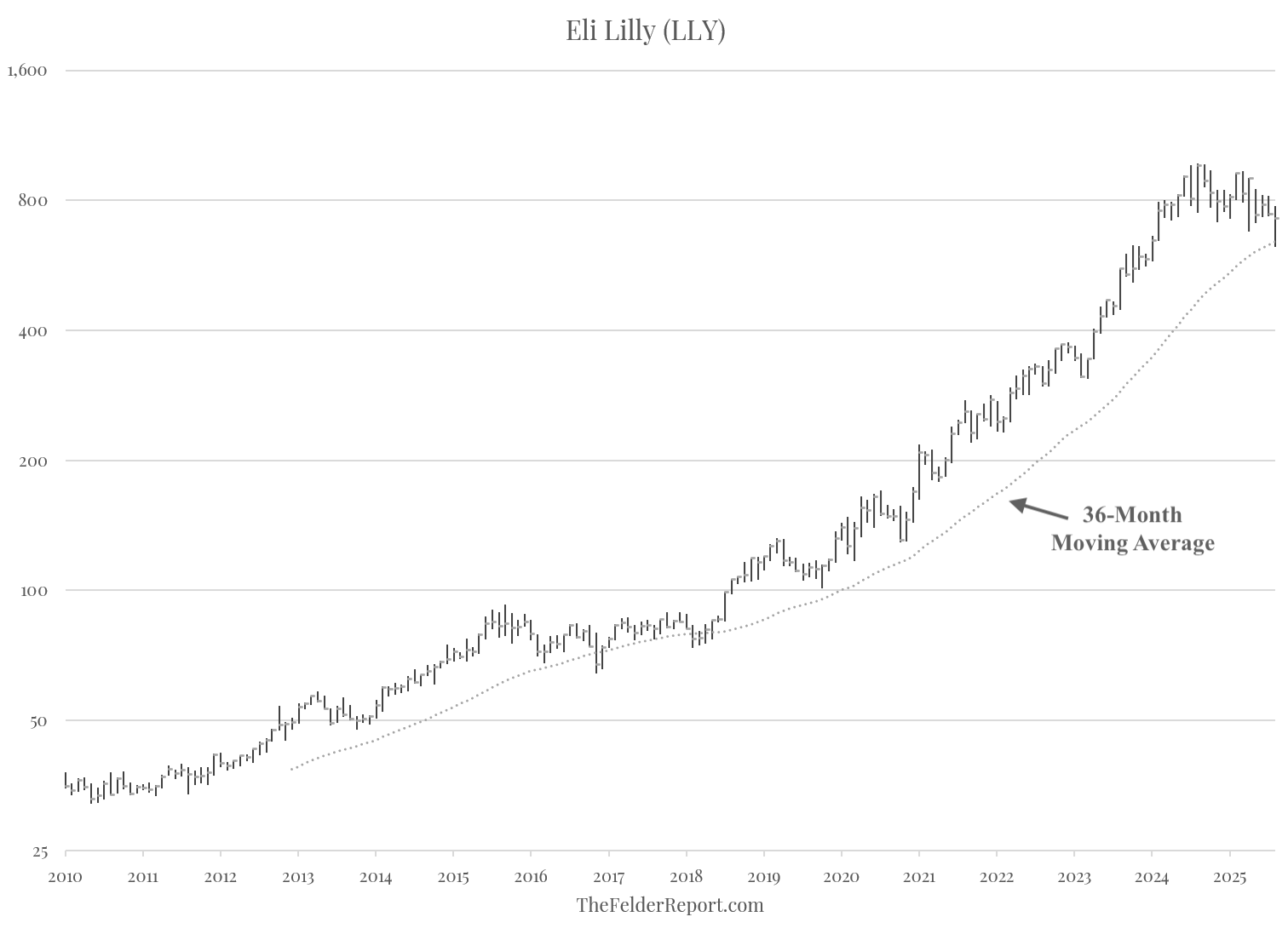
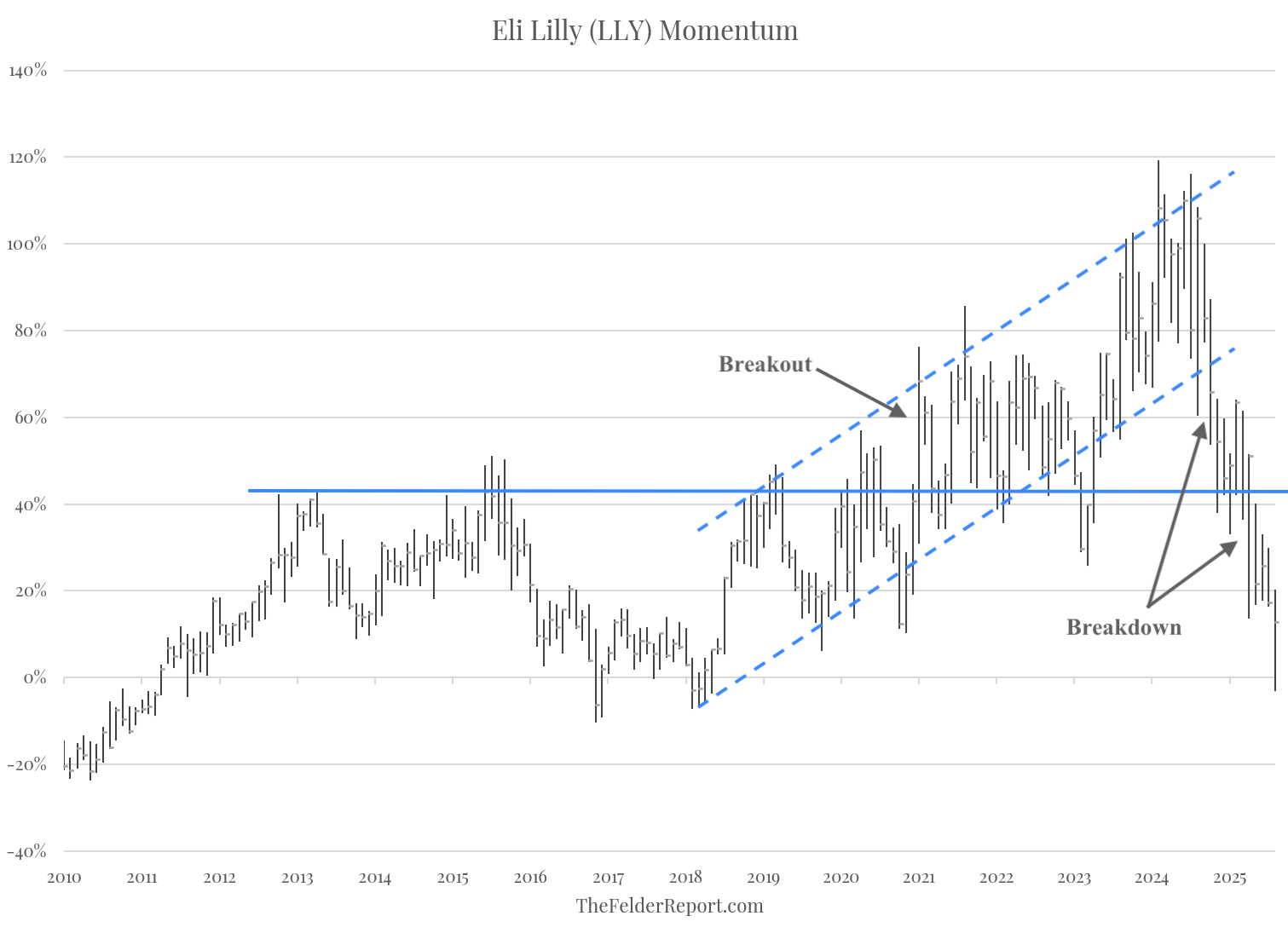
A prolonged period of basing action in the stock price may also allow the valuation to improve, making the shares more attractive from a fundamental perspective. So this looks like another one to put on the radar for now, to see if a better setup materialized in the future.
