
Perhaps the hardest part about investing is that, in the words of Walter Deemer, “when the time comes to buy, you won’t want to.” Convincing anyone (yourself included) to buy at the bottom (or to sell at the top, for that matter) is usually a Herculean task.
Back in 2009, you couldn’t get a single soul interested in buying stocks; they were just still too shell-shocked from the crash. In 2012, you couldn’t get anyone to consider buying residential real estate as an investment; in the midst of mass foreclosures and economic malaise it just felt too scary. In 2015, the idea of buying gold sounded so ridiculous, it was publicly ridiculed by the Wall Street Journal. And in 2020, investing in oil and gas companies literally became taboo.
Of course, each of these examples proved, in hindsight, to be truly wonderful buying opportunities for long-term investors. The lesson to be learned from this is that the point at which an investment opportunity is most attractive is also the point at which it is most difficult emotionally to buy. It’s really quite tragic for investors in a general sense but I guess this is simply the nature of the beast.
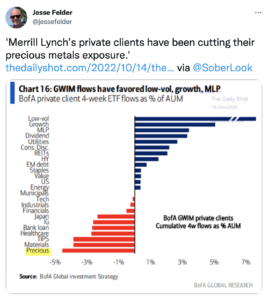 And it’s the tragic aspect of this dynamic that comes to mind when I see statistics like we are seeing today in the markets for precious metals. Outflows from gold funds just saw their longest streak since 2014 as the precious metal has once again become the most hated asset in the market. At the same time, buyers in China, India and Turkey apparently can’t get enough of the yellow metal resulting in a “global migration” of gold inventories. This might not be another “gold is a pet rock” moment but it certainly feels close.
I use the word “tragic” because there is a very real possibility that western investors will soon come to view the precious metal in the very same light as their eastern counterparts do today. Asking anyone in Turkey why they are so keen to buy gold today is like asking a man who just crawled across the Sahara why he’s so thirsty. It’s not a matter of fear or greed, as is the case most of the time in markets, as merely a matter of survival.
While the example of Turkey is an extreme one, it is still a valid cautionary tale to investors in the west. When fiscal and monetary authorities both abandon sound principles, an inflationary spiral ensues as the currency rapidly loses purchasing power. This is the simplest explanation of what is happening in Turkey. Ironically, it is also an accurate description of what is going on in the west, to varying degrees.
What has gone on in the U.K. recently is evidence of this but, as I have noted in recent market comments, what is true of the U.K. is at least as true for the U.S. if not even more so. Over the course of the current economic cycle, interest rate suppression by the Fed (in coordination with its G7 counterparts) has enabled and even endorsed a rapid increase in the federal debt relative to the economy. Federal debt-to-GDP in 2007 stood at 63%; today it’s roughly double that level.
As a result, policy makers have become accustomed to pushing the boundaries of what is fiscally possible, confident in the knowledge and the tacit assurance from the Fed that the monetary authority will make it all work out in the end by way of monetization. As we were all so rudely reminded this week, however, there is only one problem with all of this and that is that it inevitably leads to inflation.
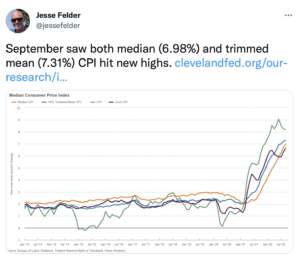 Headline CPI for September came in at 8.22% but it was the 6.6% reading in core inflation that was most concerning. Helped by declining energy prices, headline inflation has now fallen every month from its June peak of 9%. Core inflation, however, is still making new highs. Even more worrisome is the fact that median CPI, trimmed mean CPI and sticky price CPI all continue to make new highs. In other words, the underlying trend in inflation is still accelerating.
Inflation, however, is a very loaded term so it probably makes some sense to really nail down what is actually happening here. It is the purchasing power of the dollar that is declining at an accelerating pace as the result of the abandonment of sound fiscal and monetary policymaking. And the only thing preventing inflation from spiraling into something even more problematic, ala Turkey, is the credibility of the Fed in preventing such an outcome.
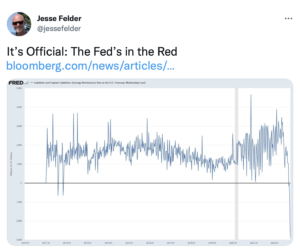
That credibility, however, is more vulnerable today than it has ever been. As Joseph Wang, a former trader on the central bank’s open markets desk, told Bloomberg, “The 75 basis point September rate hike pushed the Fed into an operating loss. With expectations for a ‘higher for longer’ Fed, the operating loss is likely to significantly increase in the coming months.” What’s more, as my friend John Hussman points out, if the Fed were to mark its bond portfolio to market today, the losses would now render it insolvent.
The growing operating losses and insolvency issues would obviously be a problem for any other financial institution. For the one that writes its own accounting rules and can make the “money printer go brrr” though it is merely one of optics. Considering the challenge to the Fed’s credibility posed by the growing inflation problem, however, this blow to its image could prove more significant than it would otherwise seem.
 Even if inflation doesn’t become an even bigger problem than it is currently, however, it is crucial to recognize that a certain amount of inflation is desired, in fact, desperately needed by policymakers today. My friend David Hay reminds us, by way of Ludwig von Mises, “The most important thing to remember is that inflation is not an act of God; inflation is not a catastrophe of the elements or a disease that comes like the plague. Inflation is a policy.”
Due to the massive levels of debt that have been built up in recent years, history suggests inflation is the most obvious policy choice. As Russell Napier told The Market last week:
Engineering a higher nominal GDP growth through a higher structural level of inflation is a proven way to get rid of high levels of debt. That’s exactly how many countries, including the US and the UK, got rid of their debt after World War II. Of course nobody will ever say this officially, and most politicians are probably not even aware of this, but pushing nominal growth through a higher dose of inflation is the desired outcome here. Don’t forget that in many Western economies, total debt to GDP is considerably higher today than it was even after World War II.
In other words, for all the talk coming out of both the Eccles Building and the White House about bringing inflation back down to 2%, that is something the country simply cannot afford. In this light, it’s much easier to understand the Fed’s shift in inflation targeting (from a ceiling to an average of 2%) when the debt exploded in the wake of the pandemic. Encouraging and even provoking the inflationary episode we are living through today was no mistake; it was a policy choice.
Now if this is true, how does it affect the Fed’s determination to bring inflation back to 2%? The answer should be obvious. Not only are the risks to financial stability too great to actually accomplish this, so are the economic consequences in a world that has become so highly indebted. Ideally, the Fed would like inflation to come down some but to remain elevated relative to recent history and for years to come. And they clearly have the power to make it happen.
To make sure inflation doesn’t run out of control in the short run, however, Jay Powell has to make investors believe he is the second coming of Paul Volcker even if this is nothing more than an elaborate bluff. At some point, though, it will become clear that inflation is not going to return to the Fed’s publicly stated target even on an average basis. At that point, western investors will understand intimately why their eastern counterparts just can’t get enough gold.