

For most, the car buying experience is not only a major hassle but one of the least enjoyable things in life, right up there with going to the dentist and paying taxes. For me, though, the car buying process is something I have always perversely enjoyed. When you’re a true value investor, it extends to every area of your life no matter how trivial, including buying a car. And there’s nothing quite as satisfying as knowing you got a great deal on a new car.
Back in January, I was in the market for a car. I wasn’t too far along into the research process, though, before I came across Carvana’s website. Curious about the company as I had been watching the stock price rise nearly 20-fold from the pandemic low to its August high last year, I went through the process of selecting a vehicle. Before I knew it I had bought a new car (nearly new, actually) that was scheduled to be delivered to my front door in a few day’s time.
The car arrived and my wife and I took it for a brief test drive. It was in excellent condition, exactly as promised by the detailed description and photos on Carvana’s site so we told the deliver driver he could leave it with us. Over the next couple of days we continued the extended test drive, looking for anything that might deter us from keeping the car but, despite our efforts, we couldn’t find any reason not to park it in the garage permanently.
Overall, the experience was so vastly better than any other car buying experience I’ve had that I don’t think I’ll ever buy a car anywhere else ever again. And I don’t say that lightly. In every other car buying experience I have had I felt like I gave up something in order to get a deal done. Whether it was price, color, options or convenience, something wasn’t quite right. Most of the time, I found the exact car I wanted but to get a great deal on price it took a great deal of negotiation and then paperwork, etc.
With Carvana, I really felt like it was the first time I felt like I didn’t give anything up. I got the exact car I wanted for a great price and I can’t imagine the process ever being any easier than it was. It was just one of those buying experiences where you decide from that point on that you’ll never go back to the old way of doing things. (For the record, Carvana has not compensated me in any way for writing this.)
But, in many cases, what makes for a great customer experience can also make for a terrible investment experience. In fact, this may be more the rule than they exception to it over the past several years. Countless companies founded over the past decade have made it their mission to burn massive piles of cash in the service of delighting their customers and venture capital firms have, until now, been overjoyed to foot the bill.
As a consumer, I love these business models, take full advantage of them and am truly grateful to all the VC’s who made them possible. As an investor, however, I don’t have the slightest interest at all in throwing my own cash into these company’s white-hot incinerators. But I don’t think Carvana is one of them. It has taken a tried and true business model and just updated it for the 21st century.
As much as the likes of Chase Coleman and Lawrence Burns, two of the stock’s largest (bag) holders, would argue otherwise, Carvana is really just a used car dealer. What makes the company different than others is that it has finally figured out how to profitably sell cars on the internet. Everything else is essentially the same. In fact, CEO Ernie Garcia III created the company within his father’s used car dealership (DriveTime) simply as a way to offer its customers a more convenient experience in buying or selling a vehicle.
What further sets Carvana apart from other used car dealers is the nationwide infrastructure the company has built in order to enable it to cost-effectively sell cars over the internet and deliver them directly to consumers front doors. No other company is anywhere close to matching it in this sense, which gives it a terrific competitive advantage in the unique niche it has carved out of the larger used car business model. And because Carvana only has about 1% marketshare at present, the opportunity for growth is still huge.
So I was intrigued when I saw insiders start buying Carvana shares in the open market recently. Back in April, in order to close its acquisition of Adesa (the country’s second largest used car auction marketplace), Carvana issued 15 million new shares at $80 per share. Garcia and his father purchased nearly half of those for about $560 million. Director and former Vice President, Dan Quayle, recently bought 18,750 shares at $39 and, more recently, Chief Counsel, Paul Breaux, bought 59,000 shares at about $30.
Today, the stock sits at just $25, down from from a high of $375 last August. That’s a 93% decline in less than a year’s time. I won’t argue that the decline is not well-deserved. At $375, Carvana, like many other Tiger Global and Baillie Gifford favorites, was astronomically overvalued. What’s more, the limited supply of new cars as the result of widespread supply chain issues has resulted in a relative boom in both the sales volumes and selling prices of used cars recently, a trend that’s likely not sustainable.
Now the elevated prices of used cars along with rapidly rising interest rates are making it more difficult for consumers to afford to make a purchase and this is before taking into consideration the overall effects of rapidly rising inflation on their finances. There’s also a good chance the economy may be headed for recession. In the midst of all of this, Carvana has spent big on both inventory and infrastructure, anticipating that the demand over the past couple of years would continue through 2022. Whoops.
So the decline in the stock price is totally warranted. At $375 the stock price essentially assumed Carvana would become the Amazon of automobiles and then some! But at $25 the stock now discounts a much less optimistic future than it did just a few months ago. In fact, it trades at just 0.5 sales today, its lowest valuation since coming public five years ago and roughly in line with its peers in the industry like CarMax, Lithia Motors, and AutoNation – this even though it is growing much faster and its opportunity to continue to do so is as bright as ever.
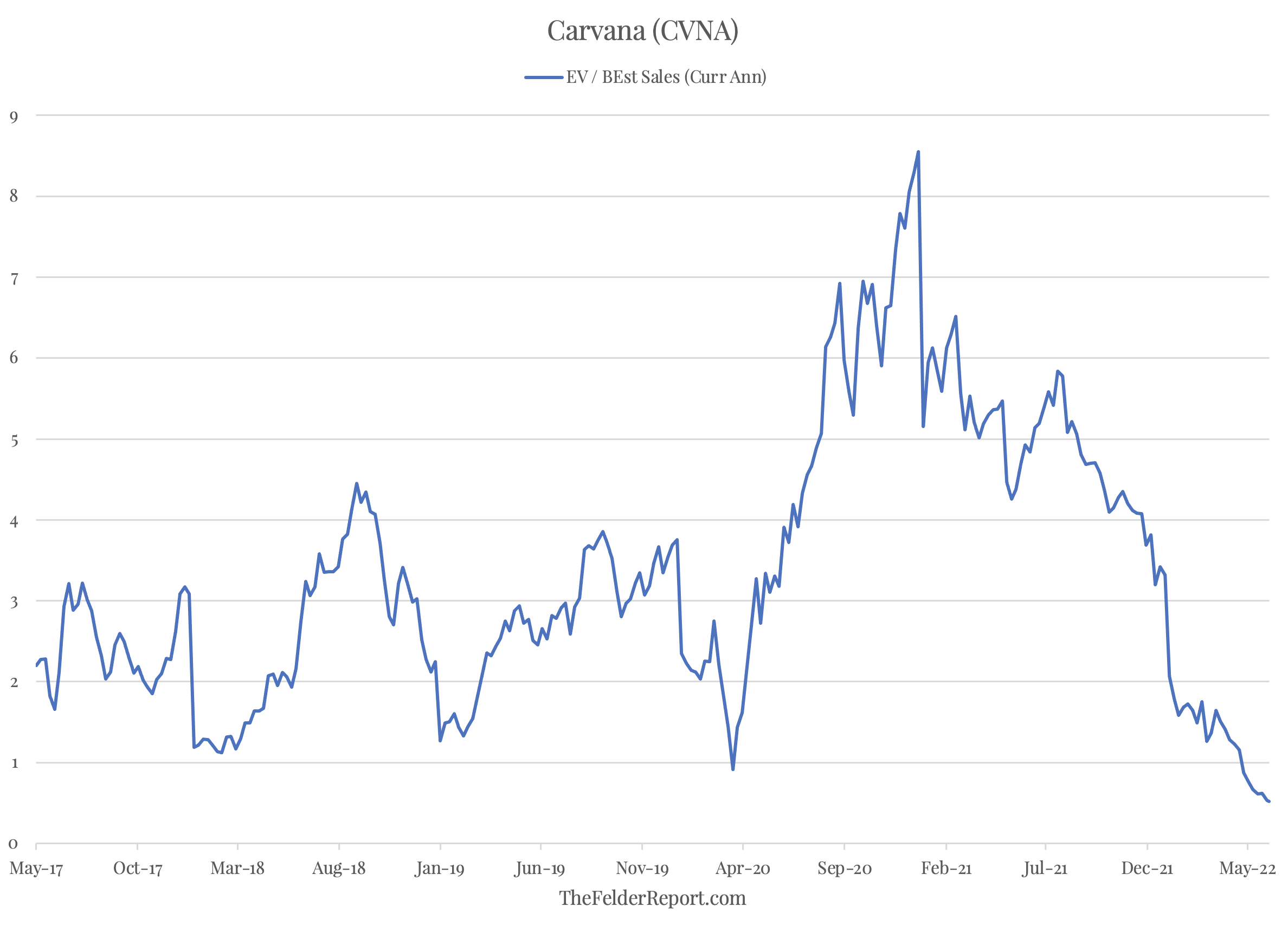
To be bullish on the stock then, simply requires that you believe the company will survive any recession that comes along (and its recent capital raise along with the deep pockets of its CEO makes that extremely likely) and that it will continue to grow at about 20-30% per year as it continues to gain market share. Assuming the valuation simply stays where it is, that allows for the stock price to appreciate in line with the company’s top line growth.
From a technical perspective, the stock shows signs of waning downside momentum, a key thing to look for in stocks like these where a purchase is truly an attempt to catch a falling knife. On a weekly time frame, CVNA just completed a new DeMark Sequential Buy Countdown (13) and a new Buy Setup (9) just as the stock tests long-term horizontal support. The daily chart (not pictured) also shows a 13 Buy Countdown triggered on June 1st along with bullish divergences in RSI and Money Flow, pointing to the potential for a short-term reversal.
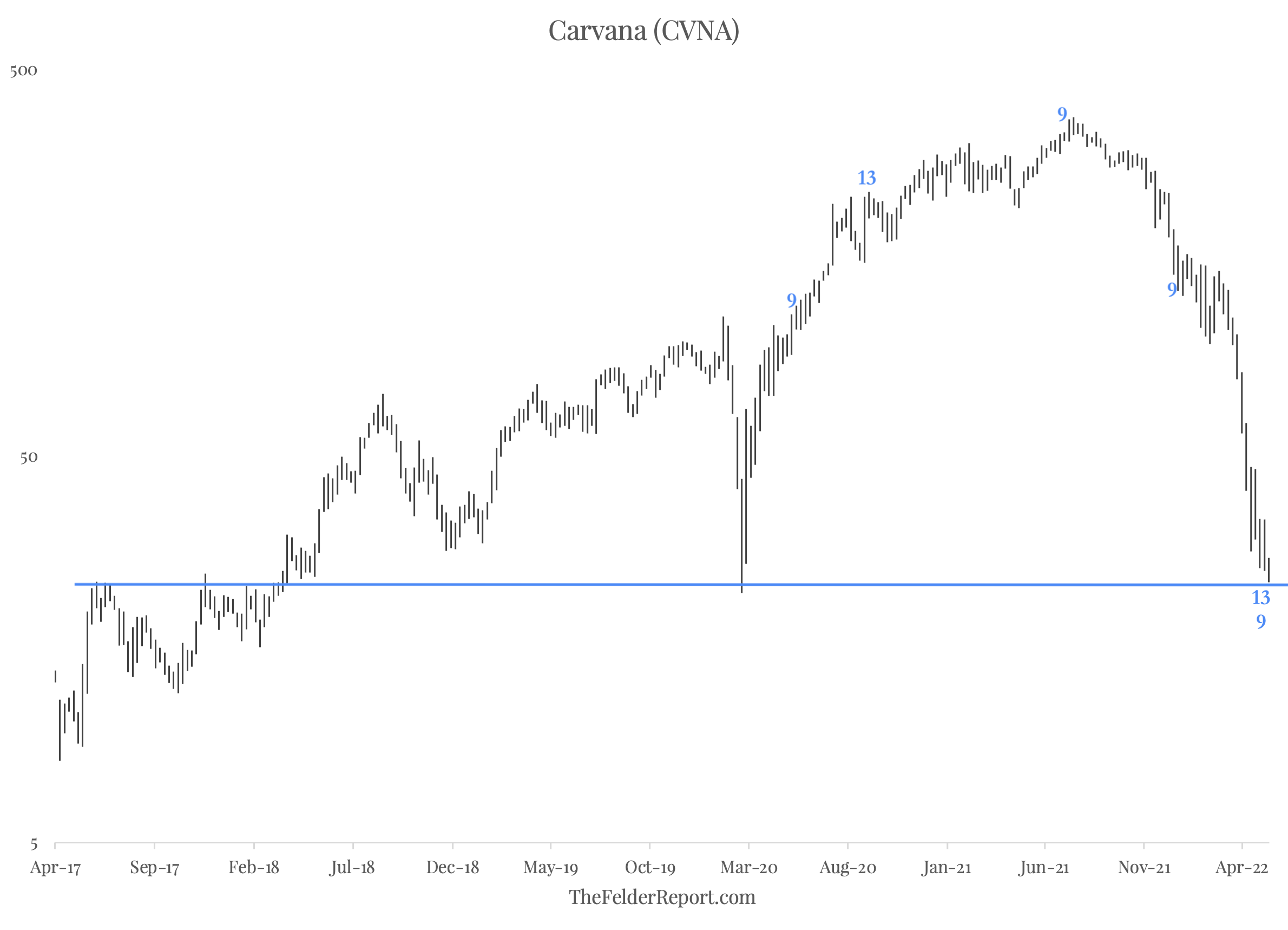
With such strong downside momentum over the past several months, however, this is a situation that warrants caution. Even if the stock did turnaround quickly here, I wouldn’t be surprised to see it test these prices again and even break below them at some point in the future as it works off that bearish momentum. And there’s also a good chance that momentum and low liquidity just carry the stock price significantly lower in the short run.
Still, it might make sense to at least put on a starter position here as there are signs pointing to the potential for a washout low. At the same time, the potential for Carvana to continue to gain share in the used car market in the years ahead, in an industry that has proven its profitability for a century now, appears to be significant. Hopefully, as the result of these bullish technical and fundamental signs, new investors to the stock will have as positive an experience as I did as a customer.
