

The major financial media outlets have finally caught up to the fact that insider selling has soared this year. CNBC recently reported, “CEOs and corporate insiders have sold a record $69 billion in stock in 2021, as looming tax hikes and lofty share prices encourage many to take profits.” The Financial Times notes, “While the spate of selling has made the software sector stand out, the founders of some of the most valuable tech companies have been the biggest individual sellers this year.”
Last week, Bloomberg joined the party in reporting, “Mark Zuckerberg sold Meta Platforms Inc. stock almost every weekday of this year. The founders of Google began to unload shares in May, which is also when two of the three Airbnb Inc. co-founders started diversifying their stakes. The transactions are part of a surge of selling by the very richest Americans.” Of course, Elon Musk has sold 10% of Tesla stake in recent months and Jeff Bezos has sold a record amount of Amazon stock (for him or any other insider), as well.
 Normally, any one of these situations would grab my attention. When you see a company founder selling it’s usually a very good sign that, at the very least, the company’s glory days are behind it. Even if it is not indicative of fraud, as was the case for Bernie Ebbers or Ken Lay selling out of their Worldcom and Enron stakes 20 years ago, these sorts of liquidations regularly prove to be bearish omens. Just look at Intel after Andy Grove sold out. The shares have gone exactly nowhere in the two decades since.
And, as a group, I think there’s a very good chance we will look back at the massive sales being transacted today by the smartest of the smart money in the world of Big Tech and think, ‘How could anyone have thought it wasn’t a sign?’ Because it is so widespread, not relegated to just one or even a few companies but the entire group, it could eventually prove to be a clear marker of the end of the glory days for Big Tech as a whole.
While the major media outlets like to pin the selling on potential tax changes next year and elevated valuations, I think they are missing this crucial point, a point which those closer to the sellers seem more willing to acknowledge. Elizabeth Sevilla, a Silicon Valley advisor to many of the tech founders leading the selling this year, told Bloomberg, “A lot of our clients are selling. They’re looking at the market and saying, ‘We’re at the top of the market.'” That’s a bit more direct than, ‘Insiders sell for many reasons; there’s only one reason for them to buy,” as many Wall Street pundits like to say.
The truth is insider selling is just as valuable as buying is in trying to understand what the future holds. In his book, Investment Intelligence From Insider Trading, Nejat Seyhun writes, “Aggregate insider trading predicts aggregate stock returns. The strength of the the aggregate insider-trading signals increases with the aggregation period. Hence aggregating insider-trading signals over the past 12-month period gives more reliable signals than aggregating insider-trading signals over the past month or the past 3 months.” Furthermore, “Aggregate insider trading predicts changes in future economic growth up to two years ahead.”
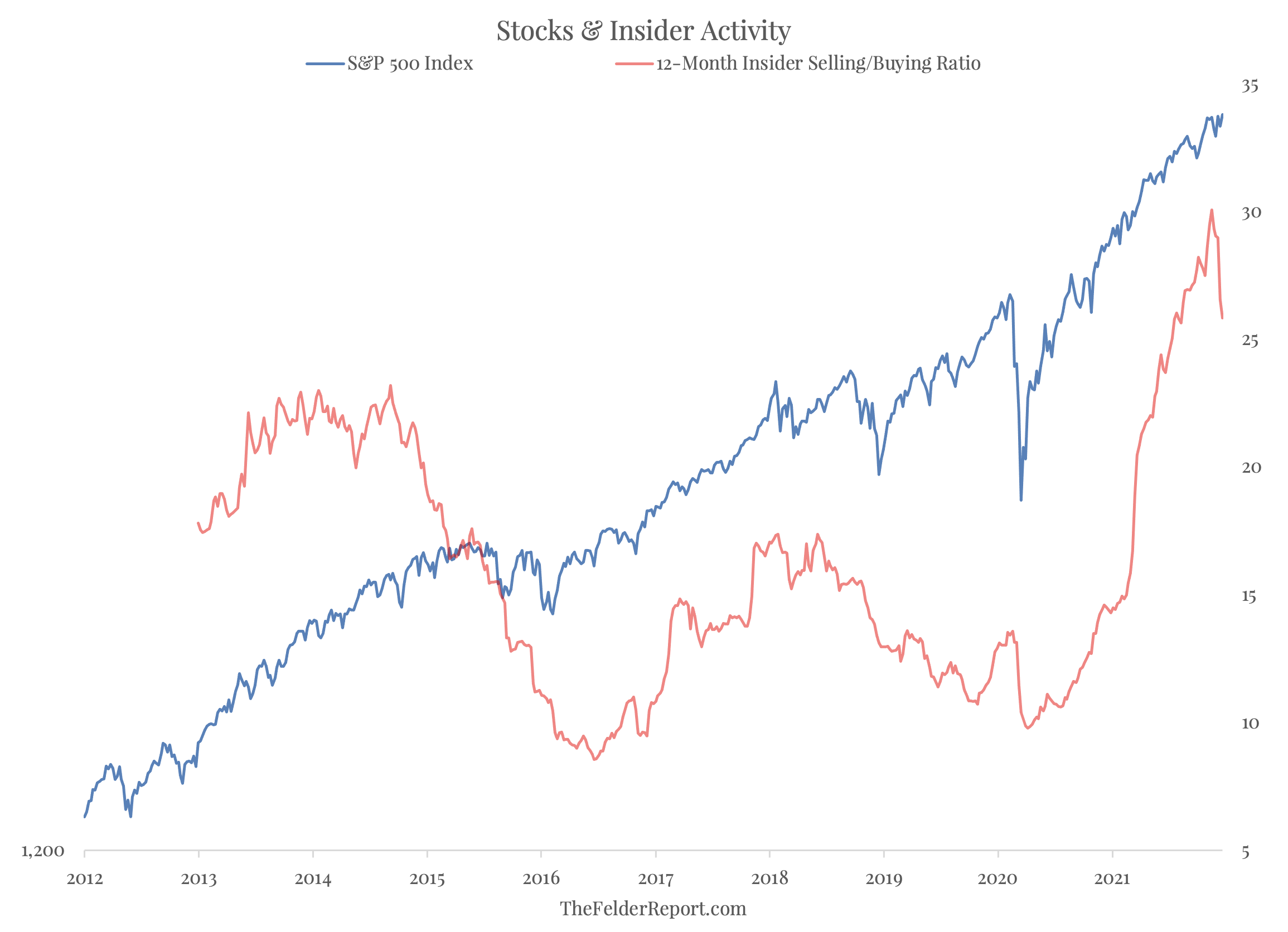
This aggregate insider trading picture is best represented by the 12-month sell-to-buy ratio. This is simply the total value of all insider sales over the past twelve months divided by the the total value of all of the insider buying over that span. This ratio recently eclipsed 30. To put this number into some perspective, at the Covid lows, the ratio bottomed around 10. The last time the ratio was over 20 was back in 2014. S&P 500 earnings peaked in the third quarter that year and declined about 10% over the next two years. As a result, stocks went sideways over that span.
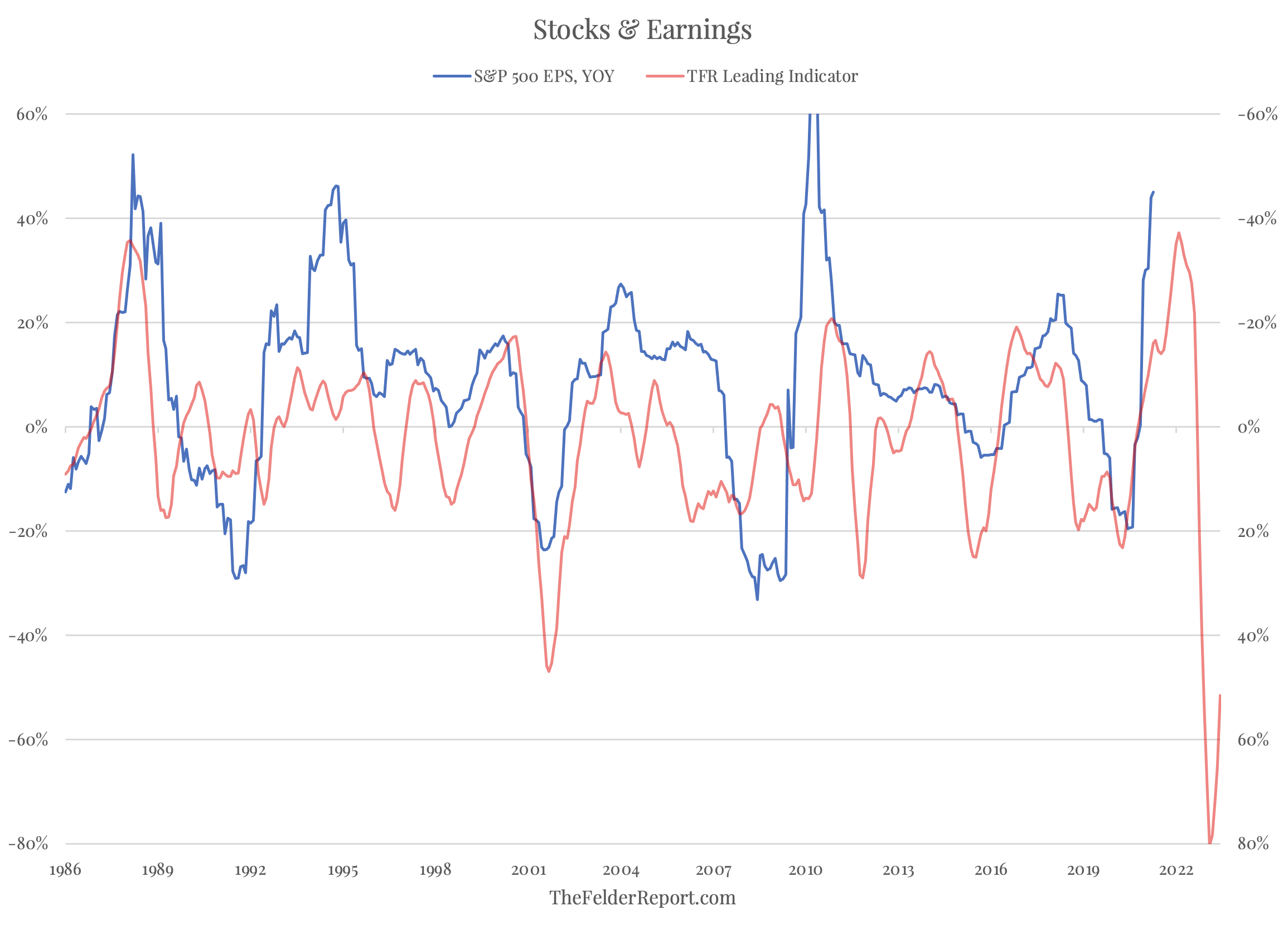
Through this lens it’s not hard to infer why these Big Tech Billionaires are selling like there’s no tomorrow: fundamentals (namely revenues and earnings) on a very large scale are peaking and rolling over. Compounding the issue is that investors seem to be discounting just the opposite outcome as valuations hit new records. As the Wall Street Journal noted recently, “The trailing price-to-earnings ratio of the S&P 500’s top 10 constituents in November was 68% above their average multiple over the past quarter-century, which includes the tech bubble years.” The forward price-to-earnings ratio for the Nasdaq 100 stands at 30, 50% higher than its average over the five years prior to the pandemic.
 At the same time as these Dotcom-bubble-beating valuations rise, revenue and earnings growth for these companies are already expected to plunge in the next couple of quarters. For example, Apple’s revenue growth is expected to disappear completely next year while earnings by the second quarter are expected to turn negative. Both Meta (formerly Facebook) and Alphabet (formerly Google) are expected to see similar earnings declines by mid-year. Amazon’s revenue growth is expected to fall to the lowest level since the Dotcom bust and earnings are already falling dramatically.
These companies are merely representative of a larger trend in the tech space. To a great extent, the tech sector benefitted by the onset of the pandemic. For a company like Amazon, the reasons should be obvious; ordering online was the only option for many folks forced to stay home. For others, the reasons are less obvious but it’s clear that the pandemic stimulus resulted in a surge in demand for all sorts of tech products and services. Mail people checks and they’re going to upgrade to a new iPhone or computer to enhance their work-from-home experience. Give small business free money during lockdowns and they’re going to spend it on Facebook and Google advertising to try to stay present in the minds of their sequestered customers.
At the end of the day, though, both effects, of the pandemic and the fiscal response, end up creating a pull-forward of demand that is very similar to what we saw in 1999 in the lead up to “Y2K.” Back then, many companies were worried that their technology infrastructure would not be able to handle the simple change in the calendar (believe it or not) and so they went through a massive, coordinated upgrade cycle. In the wake of this tidal shift in corporate purchasing, there was a vacuum of demand for both hardware and software. This vacuum was one of the catalysts for the Dotcom bust in 2001 and 2002.
In some respects, it appears we could be witnessing a similar vacuum of demand for tech products and services of all sorts in the quarters ahead. Certainly, it wouldn’t be surprising to see insider selling portend just such an outcome. But what makes this episode unique is that it also comes amid a surge in inflation unlike anything we have seen in decades. And as Fidelity recently pointed out, inflation is tech stocks’ kryptonite.
In a piece titled, “Could Technology’s Leadership Be Over?” Director of Quantitative Market Strategy, Denise Chisholm, writes, “Historically, the faster inflation has risen, the worse tech’s returns have been relative to the overall market… The tech sector has tended to underperform during inflationary periods regardless of the health of the economy. Since 1962, technology has performed poorly relative to the broad market during both inflationary economic booms and inflationary busts.” With inflation now rising faster than any time since the early-1980’s, it would seem that the risk right now to record tech stock valuations is extreme.
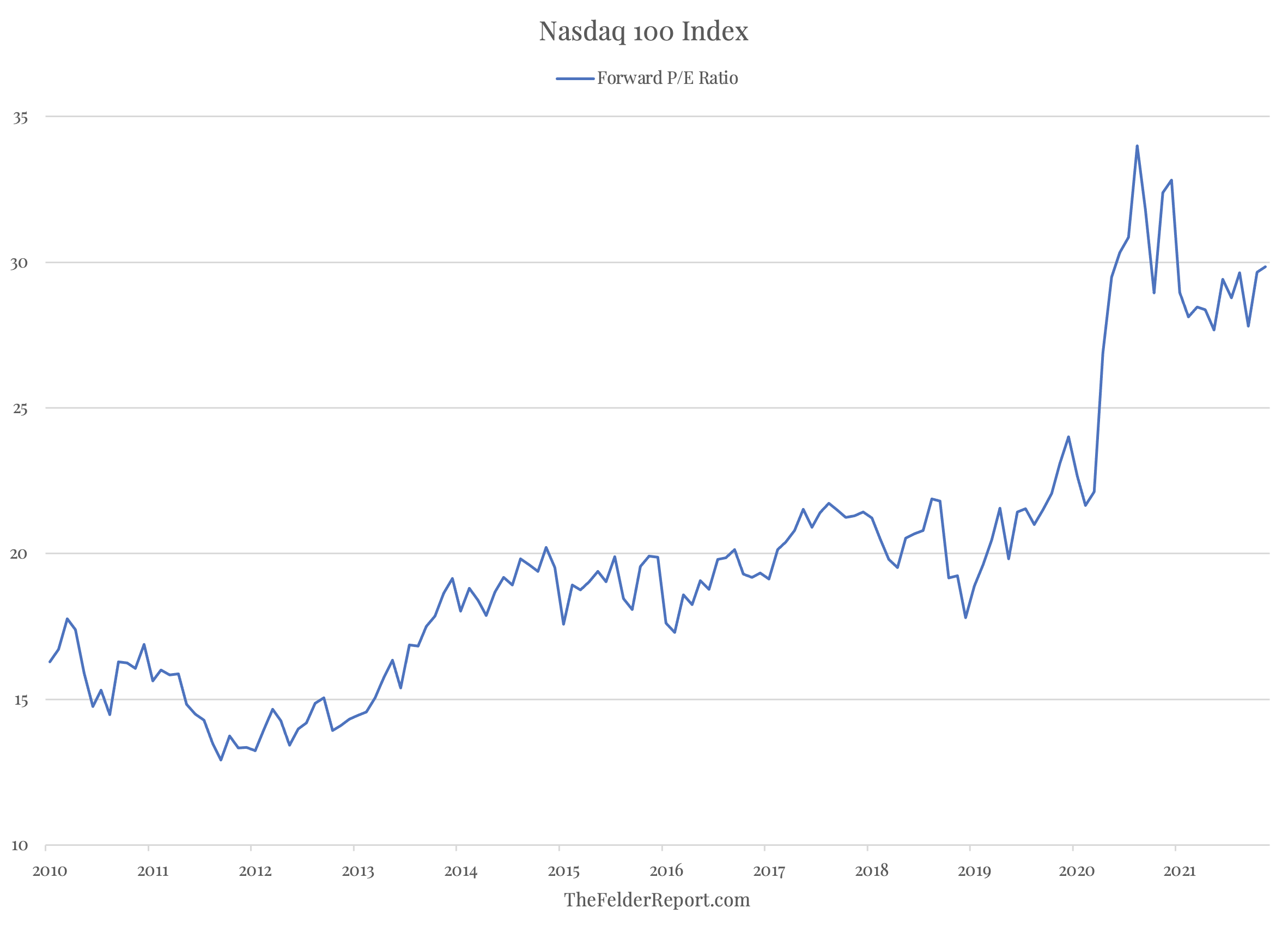 Chisholm continues, “Earlier this year, leading economic indicators (LEIs) surged to their biggest year-over-year improvement since at least the late 1970s. It may seem counterintuitive, but in the past technology stocks have fared very poorly after peaks in LEI growth. In fact, after previous top-decile leading indicator gains, technology underperformed the broad market by an average of more than 10% in the ensuing 12 months.” So tech not only has the headwind of rising inflation to deal with but it also has the dynamic of slowing economic fundamentals which, as noted earlier, appear to be hitting it harder than other sectors.
To make matters even worse for Big Tech, there is also the prospect of increased government regulation. This has been brewing for some time now but with Democrats’ control of congress and the rise of inflation, it might finally come to fruition. Just listen to the messaging out of the White House and its clear to see that they view tackling corporate concentration, for which Big Tech has become the poster child, as one of the primary tools for addressing inflation. With the midterm elections approaching they are going to feel a great deal of pressure to bring these policies to bear if only to appear as if they are being proactive.
So there is a unique confluence of bearish factors that suggest the reason Big Tech insiders are selling like there’s no tomorrow is because there really is no tomorrow – or at least no tomorrow that will look nearly as attractive as today for cashing out. In the short run, the unique set of circumstances that led to a one-time surge in demand is now shifting into reverse. In the long run, both the persistent disinflationary backdrop that boosted valuations and the ultra-loose regulatory framework that allowed for monopolistic behavior are quickly fading into the distance of the rearview mirror.
In this context, it’s hard to imagine insiders not taking advantage of the most extreme valuations in history by offloading their stakes in their own companies in a way we have never seen before. For years, they have been able to trust in the idea that, due to their seemingly unending growth and the supportive macro backdrop for valuations, stock prices would always be higher tomorrow than they are today. Clearly, that is no longer the case.